

In today’s newsletter, we unpack the regulatory landscape for SPVs in California – what SPV sponsors, fund managers, and structurers need to know to stay compliant. I will specifically address the California Financing Law (CFL) licensing and the AB 2981 exemption. Important to know both to avoid a situation where your SPV got a lender’s license and didn’t even know it. SyndiCat gives you an analogy.
1. CFL Licensing
- Under the CFL, any “finance lender” making commercial loans in California generally needs a license.
- Historically, there was a “de minimis” exemption that exempted entities making no more than one commercial loan in 12 months. So most SPVs investing through loan-like instruments were fine.
- However, that exemption was repealed as of 01/01/2022.
- As a result, many SPVs that made single big commercial loans to fund specific projects may now be in unlicensed territory unless they restructure or obtain a CFL license.
2. AB 2981 exemption
- AB 2981 (2024) provides a pathway for SPVs to bypass full license application if:
- If these conditions are met, the entity is “deemed a licensee” under CFL – potentially easing the administrative burden of filing explicitly for a license.
That said, AB 2981 does not create a full exemption. Entities satisfying its criteria are treated as licensees, not as non-licensed actors.
3. Legal Enforceability
Even if an SPV is unlicensed under CFL, California courts have held that a commercial loan is not necessarily void just because the lender does not have a CFL license. So you can enforce to get your money back but are still in the red with the regulators.
When CFL does not get triggered
Good news first – CFL doesn’t automatically get triggered if the portfolio company is in California. So if your SPV buys equity (SAFE, pref & common stock) in a CA company, you are not a lender, and CFL does not apply. You could be investing in a start-up on Market Street – still no CFL.
Also excluded are VC companies (per CA’s statutory definition) extending commercial bridge loans to their portfolio companies.
Defining a CFL “loan”
Under CFL, a “loan” includes essentially any transaction where the SPV advances money and expects repayment. These instruments are convertible notes, venture debt / term loans, bridge notes, revenue-based financing, secured lending and intercompany loans. Instruments not covered are straight equity (preferred, common), SAFEs (because they have no repayment obligation), warrants and LP interests. A cheat sheet below:
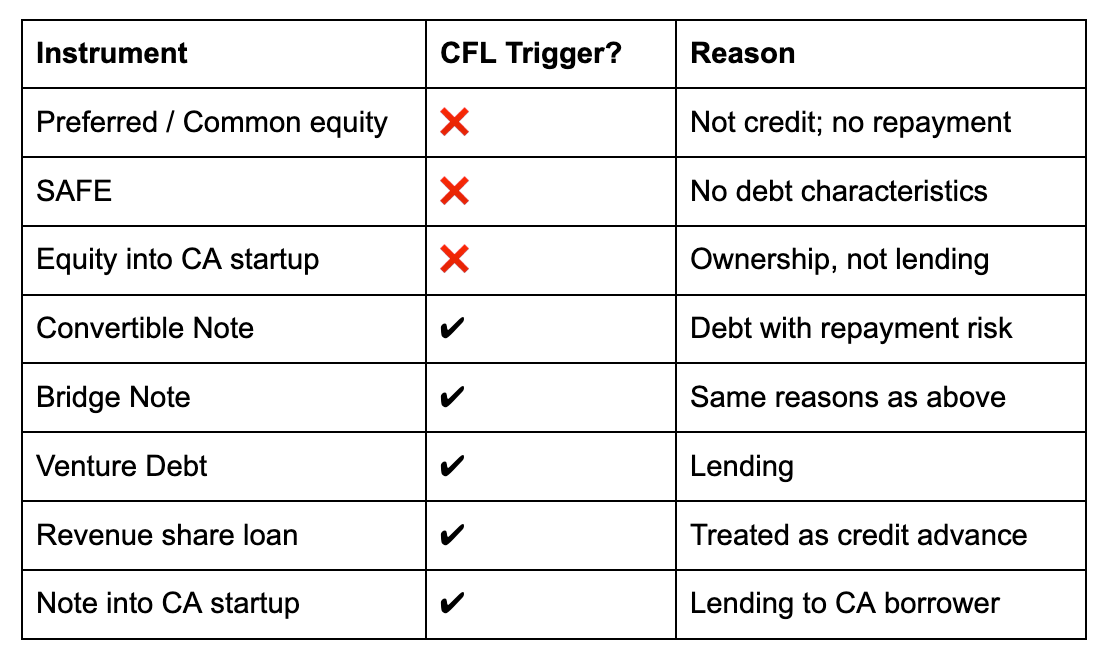 |
If the investor’s return depends on ownership, not repayment, CFL is not triggered.
DE LLC-specific situations we commonly see at Propel(x)
a. Borrower is in CA
If the portfolio company is in California, and the SPV funds a note, the SPV has made a loan to a California borrower. Department of Financial Protection & Innovation (DFPI), California treats this as lending “in California”, even if the lender is out-of-state.
b. Any SPV manager located in CA
If the investment decisions, negotiation, or administration is being run out of California, the DFPI considers the loan originated in California.
c. Solicitation in CA
Even investor or borrower solicitation activities inside California can attach the law (suggest you check with experts).
Final Action Points for SPV Sponsors and Fund Managers
1. Reassess your SPV structures: If you have SPVs that make one or a few big loans, revisit whether they must now obtain a CFL license under the post-2022 regime.
2. Evaluate AB 2981 applicability: Check if your SPV qualifies based on loan size, volume, and activity. If yes, AB 2981 may help you avoid a full licensing process – but you still become a licensee in the eyes of the DFPI.
3. Stay current with DFPI guidance: Regulatory interpretations evolve, especially with newer statutes like AB 2981.
4. Location of SPV Manager: CLA might be applicable if the SPV manager (individual or entity) is located in CA. If you are starting fresh and incorporating your SPV manager, consider CLA applicability when choosing the incorporation jurisdiction.
5. Work with specialized counsel: Please also let me disclaim here that this newsletter is for informational purposes. Given the dual risk (securities law + lender licensing), law firms experienced in both SPVs and California finance law are critical.
Final Thoughts
California’s regulatory regime for SPVs has tightened as sunsetting of the single-loan exemption means that SPV sponsors may need to utilize the AB 2981-compliant SPV structures for lending. At the same time, you need to mind the fact that AB 2981 compliance DOES NOT EXEMPT you from becoming a CA lender – it just helps avoid the license application.
If you’re looking to create new SPVs (even rolling ones), you are welcome to browse Propel(x) SPVs page. If you want help deciding which option to choose for your next SPV, you are welcome to…
Cheers!
