

What SPV Syndicators Must Know About Identification and Filing.
What is a Central Index Key (CIK)?
The Central Index Key (CIK) is a critical part of the U.S. Securities and Exchange Commission’s (SEC) regulatory framework that uniquely identifies every filer, ensuring transparency and ease of access to financial disclosures for regulators and investors alike. It is a unique 10-digit identification number. Think of it as an account number that helps the SEC’s computer systems accurately identify and track all filings submitted by a particular filer in the Electronic Data Gathering, Analysis, and Retrieval (EDGAR) database.
Why is the CIK important?
- It ensures that filings are correctly associated with the right entity, even if names are similar or change over time.
- It helps the SEC efficiently monitor and regulate financial markets.
- It enables investors, regulators, and the public to easily access and track any filer’s filing history and financial disclosures.
- It supports transparency and accountability in securities regulation.
Please note that not all companies are required to have a CIK (e.g. some small companies that are exempt from SEC reporting may not have a CIK). But since all SPVs must file various exemption forms with the SEC, it becomes a mandatory requirement for them.
Obtaining a CIK
Entities (or individuals) who need to file with the SEC apply for a CIK by submitting Form ID, which must be notarized. Once approved, the SEC issues the CIK via email. This number must be included in all filings to ensure proper identification.
Please note that the Propel(x) syndicators get this pre-cooked and do not need to bother with the process!
Finding an existing entity’s CIK
The SEC provides public tools to look up CIK numbers. You can easily search by entity name, ticker symbol, or other keywords using the SEC’s EDGAR Company Filings CIK Lookup or EDGAR Company Database.
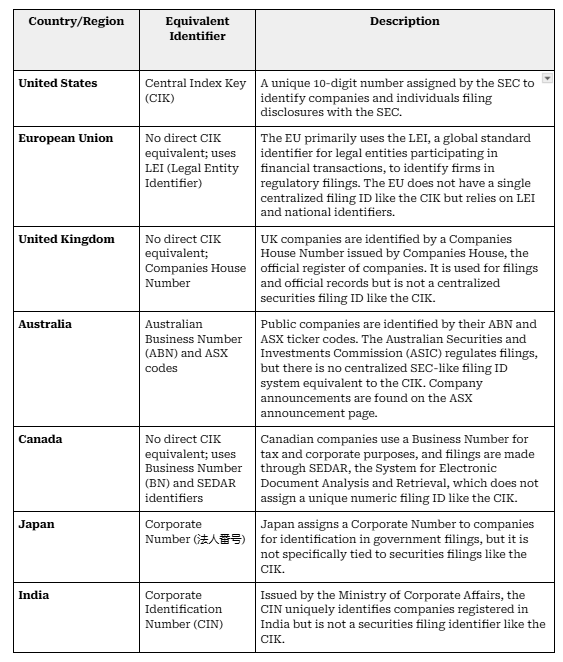
Comparing with other jurisdictions
The CIK is unique to the U.S. SEC system for identifying filers in the EDGAR database. Most other countries use company registration numbers or business identifiers for corporate identification. For securities and financial market regulation, many jurisdictions rely on the Legal.
Entity Identifier (LEI), a global standard, rather than a system exactly like the CIK.
Some countries have EDGAR-like electronic filing systems (e.g., SEDAR in Canada, ASIC in Australia) but do not assign a unique numeric identifier equivalent to the CIK for all filers.
For our non-US syndicators, we provide below a summary of similar identifiers used in some of the key jurisdictions:
Summary:
- Filing for a CIK is a key step to incorporating an SPV for your syndication
- The CIK never changes once assigned.
- The CIK is often used alongside other access codes (like passphrases and confirmation codes) by filers to submit and manage their filings securely.
- At Propel(x), we take care of filing for CIKs for your syndicates. In fact, our plug-and-play offering allows you to use SPVs with pre-filed CIKs and ready for your use at the click of a button.
