

Tokenized SPVs: Are they for you?
With all the tech innovation happening around us, it was only a matter of time before the tech touched SPVs. So now, we have tokenized SPVs… they do their traditional jobs of simplifying investment syndicates, but issue (blockchain) tokenized ownership to LPs. An interesting innovation indeed. Blockchain seems to be revolutionizing asset ownership and we already see real estate, commodities, fixed-income assets, art & collectibles, IP, environmental assets (like carbon credits)… even fiat currencies (literally) riding the blockchains. So it was only a matter of time until the PE-VC interests in SPVs hitched the blockchain ride.
What is a Tokenized SPV? It is a legal entity (usually a Delaware LLC) that holds the underlying investment – such as a startup equity stake – on behalf of its LPs and in that it is like a traditional SPV. Where it differs from a traditional SPV is that instead of offering part ownership through signed documents, it issues blockchain-based tokens representing fractional ownership in that SPV. These tokens are recorded on a private permissioned blockchain.
Tokenization brings about several benefits on the SPV ownership side:
- It lowers investment minimums as fractional tokens enable smaller checks from more investors.
- It enhances liquidity in the secondary market for SPV ownership as trading tokens is far easier than transferring document-based ownership.
- It brings about transparency and trust by providing clear ownership and transaction history.
- Smart contracts automate many manual SPV management tasks.
- It could bring in a wider pool of accredited investors who prefer digital assets.
But just because it is an innovation and has these benefits, should syndicators jump on the bandwagon? I would suggest you consider the following before you jump:
1. Regulatory Uncertainty and Complexity. The regulatory framework for tokenized securities (including tokenized SPVs) is still evolving and lacks clarity. In the US, tokens are generally treated as securities under the Howey Test, requiring compliance with SEC regulations such as registration or qualifying exemptions (Reg D, Reg A+, Reg S).
2. Security Risks. Tokenized SPVs are vulnerable to cyberattacks and hacking.
3. Liquidity Limitations. Although tokenization aims to improve liquidity of traditionally illiquid assets, tokens may still face limited tradability due to nascent secondary markets, regulatory transfer restrictions, or insufficient market participants.
4. Lack of Standardization. There is no industry-wide standard yet for tokenization platforms or token structures.
5. High Complexity and Costs. Setting up and managing a tokenized SPV involves complex legal, technical, and compliance processes. This includes drafting specialized operating agreements, developing and auditing smart contracts, implementing KYC/AML procedures, and ongoing regulatory reporting. These factors increase upfront and operational costs compared to traditional SPVs.
6. Legal and Tax Risks. Tokenized SPVs face uncertain tax treatment, including how token transfers and distributions are taxed. Changes in tax laws could negate benefits or create unforeseen liabilities.
7. Potential for Market Manipulation. Open or semi-open trading of tokens can expose tokenized SPVs to market manipulation risks, including price manipulation or fraudulent activities, which may harm investor confidence.
8. Custody and Operational Challenges. Regulatory-compliant custody of digital tokens requires specialized qualified custodians and robust security measures.
Now having listed the pros and cons, we move on to talking about if Tokenized SPVs are for you are not.
Syndicators for whom Tokenized SPVs are well-suited
- Syndicators Seeking Broader Investor Access and Fractional Ownership. Tokenized SPVs enable fractional ownership and help lower minimum investment thresholds. This is ideal for syndicators aiming to attract a larger, possibly global pool of accredited investors.
- Syndicators Focused on Liquidity and Secondary Trading. Tokenized SPVs facilitate easier secondary market trading of ownership interests via blockchain tokens (subject to regulatory compliance), offering enhanced liquidity compared to traditional SPVs.
- Tech-Savvy Syndicators Comfortable with Blockchain and Compliance Automation. Those syndicators who embrace blockchain technology and smart contracts to automate compliance (KYC/AML, transfer restrictions), distributions, and governance can reduce administrative overhead and increase transparency for investors.
- Innovative or Web3-Focused Syndicators. Syndicators experimenting with decentralized autonomous organizations (DAOs) or crypto-native investment models may find tokenized SPVs or hybrid on-chain/off-chain structures particularly attractive.
Syndicators for whom Tokenized SPVs may be less suitable
- Syndicators with Limited Regulatory and Compliance Resources. Tokenized SPVs require rigorous compliance with securities laws, including investor accreditation, transfer restrictions, and ongoing reporting. Syndicators without access to strong legal counsel or compliance infrastructure may find these burdensome and risky.
- Syndicators Preferring Simplicity and Low Setup Costs. Traditional SPVs (without tokenization) remain simpler and less costly to establish and operate. Syndicators focused on straightforward, low-cost deals with a small, trusted investor base may not benefit enough from tokenization to justify the complexity.
- Syndicators Investing in Jurisdictions with Restrictive Regulations on Tokenized Securities
Syndicators Uncomfortable with Technology or Investor Education Challenges
In Summary
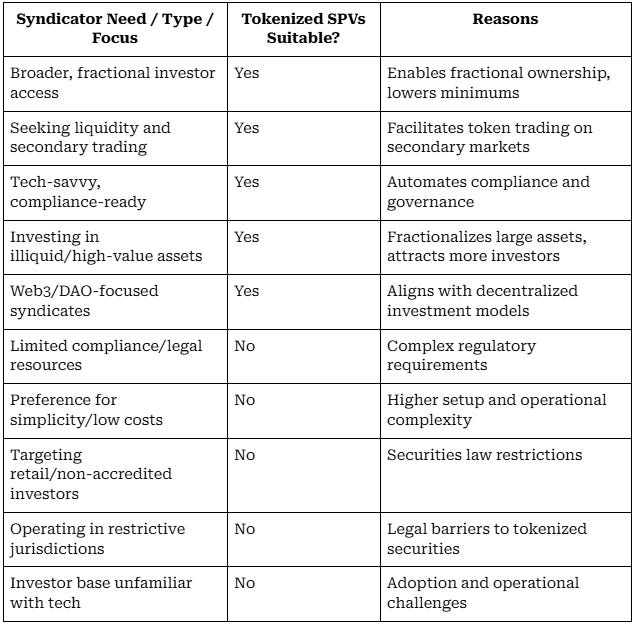
In summary, tokenized SPVs are useful tools for syndicators who want to innovate with broader access, liquidity, and automation, especially in tech-friendly and well-regulated environments. However, they are less suitable for syndicators prioritizing simplicity, operating with limited compliance support, or targeting less sophisticated investors. Using Tokenized SPVs requires a careful evaluation of your priorities in creating the syndicate. Just because this is an innovation does not mean syndicators should rush in.
Happy syndicating!
