

Exploring the ambiguities and strategic considerations for founders and investors.
In this third blog in the series on QSBS (Qualified Small Business Stock) 2.0, we explore the potential impact on SAFEs (Simple Agreements for Future Equity). Let us start by looking at SAFEs under the reigning QSBS.
QSBS and SAFEs:
- SAFEs are not immediately “stock”: SAFEs represent a right to future equity but do not grant ownership, voting rights, or a place on the cap table until a triggering event (usually a priced equity round) converts the SAFE into stock. Because QSBS benefits apply only to stock, the IRS has not definitively ruled whether SAFEs themselves qualify as QSBS.
- Holding period for QSBS exclusion starts at conversion: If the IRS treats SAFEs as not stock, the five-year QSBS holding period only begins when the SAFE converts into actual stock. This means investors who hold SAFEs must wait longer to qualify for QSBS tax benefits compared to investors who receive stock upfront.
- If SAFEs are treated as stock: Some tax opinions argue that SAFEs, especially standardized ones like the Y Combinator SAFE, could be considered “stock” for Section 1202 purposes. If so, the holding period starts at SAFE issuance, and the conversion into preferred stock is treated as a continuation of the holding period, preserving QSBS benefits without interruption.
- Tax planning implications:
- Investors seeking QSBS benefits should consider converting SAFEs into stock as soon as possible to start the QSBS holding period and reduce uncertainty.
- If a SAFE is treated as a hybrid instrument or debt, investors risk delaying QSBS eligibility and potentially losing the ability to roll over gains under Section 1045, which requires replacement QSBS to be acquired within 60 days of sale.
- The exact tax treatment may vary depending on SAFE terms and IRS interpretation, so consultation with tax advisors is critical.
- Conversion is generally non-taxable: If the SAFE is treated as stock, converting it into preferred stock is typically a tax-free event, preserving QSBS status and the holding period continuity.
Summary Table
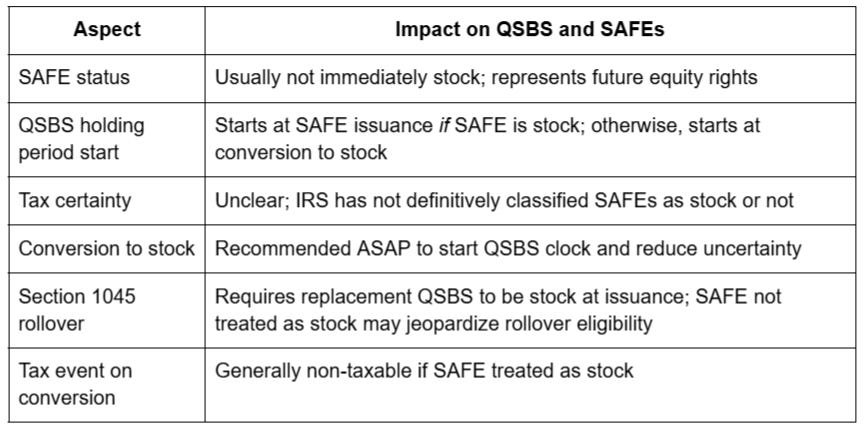
As of now, QSBS 2.0 does not yet officially exist as codified law, and therefore, it does not definitively clarify whether SAFEs or convertible notes are treated as equity for QSBS purposes. However, there is strong momentum and policy discussion pushing for clarity.
There is a possibility that under
• Section 1202 requires original issue stock.
• SAFEs and convertibles are not stock; they are contracts for future stock.
• IRS and courts may eventually interpret QSBS strictly to prevent perceived abuse of deferred risk with early tax benefits.
Summary:
For C-corps issuing SAFEs, QSBS benefits depend on whether the SAFE is treated as stock for tax purposes. Since SAFEs typically convert into stock at a later event, the QSBS holding period often begins at conversion, potentially delaying tax benefits. To maximize QSBS advantages and reduce uncertainty, startups and investors are advised to convert SAFEs into stock as soon as feasible and consult tax professionals for tailored guidance.
